Percentage Calculator
Loading the calculator... If this message does not disappear, please reload the page and make sure JavaScript is enabled.
What is X% of Y?
Example: what is 15% of 200?
Enter both numbers to see the result.
X is what percent of Y?
Example: 30 is what percent of 120?
Enter both numbers to see the result.
Percentage change from X to Y
Example: from 80 to 100 (increase or decrease).
Enter both numbers to see the result.
Increase or decrease X by Y%
Example: add 20% to 50, or take 20% off 50.
Enter both numbers to see the result.
X is Y% of what number?
Example: 30 is 25% of what number?
Enter both numbers to see the result.
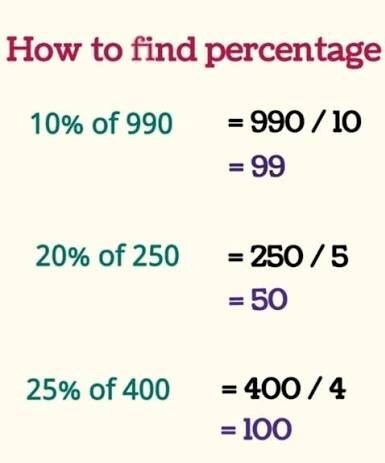
Introduction
Use this free percentage calculator to work out common percentage problems in seconds. Find a percentage of a number, see what percent one number is of another, calculate a percentage increase or decrease, add or subtract a percentage, or work backwards to find the original number. Each answer shows the working, so you can check it and learn the method. Everything runs in your browser and nothing you type is uploaded.
How to use
- Pick the card that matches your question.
- Type your two numbers.
- Read the result and the working underneath.
- Click Copy result to copy the number, or Clear to start over.
Formulas
- X% of Y = X ÷ 100 × Y
- X is what percent of Y = X ÷ Y × 100
- Percentage change = (new − old) ÷ old × 100
- Increase by Y% = X + (X × Y ÷ 100), and decrease by Y% = X − (X × Y ÷ 100)
- X is Y% of what number = X ÷ (Y ÷ 100)
FAQs
- How do I calculate a percentage of a number? Divide the percentage by 100 and multiply by the number.
- What is the difference between percentage change and percentage points? A move from 10% to 12% is a 2 percentage-point change, but a 20% relative increase.
- How do I calculate a discount? Use “Increase or decrease X by Y%” with Decrease, and enter the price and the discount.
- Why can’t I calculate a percentage change from zero? The formula divides by the starting value, and dividing by zero is undefined.
- Is my data stored? No, it stays in your browser.
What Is a Percentage Calculator?
A percentage calculator is an online tool that helps you solve mathematical problems involving percentages. It can calculate a percentage of a number, determine what percentage one value represents of another, and find the percentage increase or decrease between two values.
Percentages are used in everyday situations, including shopping discounts, exam scores, business calculations, budgets, taxes and financial comparisons. This calculator provides the result along with the working so you can understand how the answer is obtained.
How to Calculate a Percentage in Everyday Life
The word percentage means “out of 100.” To calculate a percentage of a number, divide the percentage by 100 and multiply the result by the original number.
For example, to calculate 20% of 150:
20 ÷ 100 × 150 = 30
Therefore, 20% of 150 is 30.
This method works for many everyday calculations, such as finding a discount amount, calculating a portion of a budget or determining marks obtained in an examination.
How to Calculate Percentage Increase or Decrease
Percentage change measures how much a value has increased or decreased compared with its original value. Subtract the old value from the new value, divide the difference by the old value, and multiply by 100.
Formula:
Percentage change = (New value − Old value) ÷ Old value × 100
For example, if a price increases from 100 to 120, the change is 20. Dividing 20 by 100 and multiplying by 100 gives a 20% increase.
If a price falls from 100 to 80, the change is −20, which represents a 20% decrease. The starting value must not be zero because the calculation requires division by the original value.
How to Calculate Discounts and Sale Prices
A percentage calculator can help you understand how much you save during a sale and how much you need to pay after the discount.
For example, suppose a product costs AED 200 and has a 15% discount.
Discount amount: AED 200 × 15 ÷ 100 = AED 30
Final price: AED 200 − AED 30 = AED 170
The discount amount and the final sale price are different figures. Knowing both helps you compare offers and plan your shopping budget. Always check whether any additional charges or taxes apply to the final price.
Percentage vs. Percentage Points
Percentage change and percentage-point change describe different things. A percentage-point change is the simple difference between two percentages, while percentage change measures the relative difference compared with the starting percentage.
For example, an increase from 10% to 12% is a change of 2 percentage points. Relative to the original 10%, however, the increase is 20%.
This distinction is useful when comparing interest rates, test results, business performance and statistics.
Where Can You Use a Percentage Calculator?
A percentage calculator can be helpful in many situations:
Shopping: Calculate discounts and sale prices.
Education: Work out examination scores and marks.
Business: Compare sales figures, costs and revenue changes.
Personal budgeting: Calculate spending proportions and savings targets.
Finance: Understand percentage-based changes in rates and amounts.
Data analysis: Compare changes between two numerical values.
The calculator provides mathematical results, but the correct interpretation depends on the information and context you enter.
Is This Percentage Calculator Free and Private?
The FunnLearnn Percentage Calculator is designed to calculate results directly in your browser without uploading the numbers you enter. This makes it convenient for everyday calculations. If privacy is important for your use case, verify the actual tool implementation and avoid entering confidential information into any tool whose data handling you have not confirmed.
Calculate Percentages Online for Free
Use the FunnLearnn Percentage Calculator to solve percentage problems, calculate discounts and understand increases or decreases. Select the calculation that matches your question, enter the required numbers and review the result and formula.
Note: Results depend on the numbers entered and the calculation selected. For financial, tax or business decisions, verify any relevant rules and figures before acting on the result.